



I looove animals.
I’m a veterinarian, so that probably goes without saying. I’ve spent years caring for dogs and cats, helping pet owners through difficult medical decisions, and witnessing just how powerful the human-animal bond can be.
I understand that our pets are family. They provide companionship, comfort, unconditional love, and sometimes much-needed emotional support.
But I’m going to say something that might upset a few dog owners.
Your dog does not need to go everywhere with you.
Not to the grocery store. Not to every restaurant. Not on every shopping trip.
And before someone says, “But my dog is my emotional support animal,” let’s talk about what that actually means.
Somewhere along the way, the lines between pets, emotional support animals, and service animals have become blurred. And while I understand wanting your four-legged best friend by your side, that doesn’t mean your dog belongs in every public space.
So let’s clear up some of the confusion, talk about what actually qualifies as a service animal, and why the distinction matters more than you might think.
What Is a Service Animal?
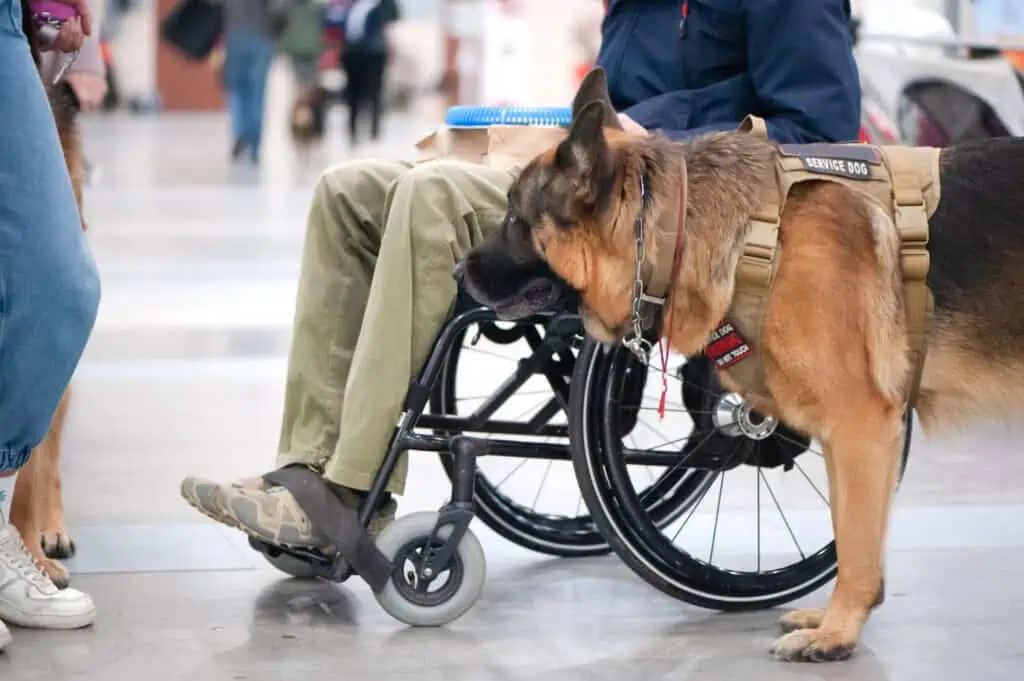
Under the Americans with Disabilities Act (ADA), a service animal is a dog that has been individually trained to perform specific work or tasks for a person with a disability.
The tasks must be directly related to that person’s disability.
Examples include:
Guiding someone who is blind or has impaired vision.
Alerting a person who is deaf or hard of hearing to important sounds.
Retrieving objects for someone with limited mobility.
Alerting or assisting someone during a seizure.
Reminding someone with a psychiatric disability to take medication.
Performing a trained action to help someone experiencing a psychiatric episode.
Service dogs aren’t simply companions. They perform important tasks that help their handlers navigate daily life.
And here’s something important: not all disabilities are visible.
A person may look perfectly healthy but rely on a service dog because of epilepsy, post-traumatic stress disorder (PTSD), or another disability.
You cannot determine whether someone legitimately needs a service animal just by looking at them.
Under the ADA, service dogs do not need to wear special vests, carry identification cards, or receive professional certification. Handlers may train their own service dogs.
The ADA also has a separate provision requiring public accommodations to consider reasonable modifications for individually trained miniature horses.
Source: U.S. Department of Justice — Service Animals
What Is an Emotional Support Animal (ESA)?
An emotional support animal provides comfort or emotional support that helps alleviate one or more effects of a person’s disability.
Unlike a service animal, an ESA does not have to be trained to perform a specific disability-related task.
For example, someone living with a qualifying mental health disability may benefit from the companionship and emotional support provided by their animal.
That support can be meaningful and important.
But here’s the distinction:
An emotional support animal is not automatically a service animal.
Under federal housing law, qualifying emotional support animals may be recognized as assistance animals. This can allow individuals with disabilities to request reasonable accommodations in housing that otherwise restricts pets.
However, those housing protections do not automatically extend to grocery stores, restaurants, and other public businesses.
An emotional support animal may be a dog, cat, or another qualifying species, depending on the circumstances.
Source: U.S. Department of Housing and Urban Development — Assistance Animals
Service Animal vs. Emotional Support Animal vs. Regular Pet
Here’s a simple breakdown of the differences under US federal law.
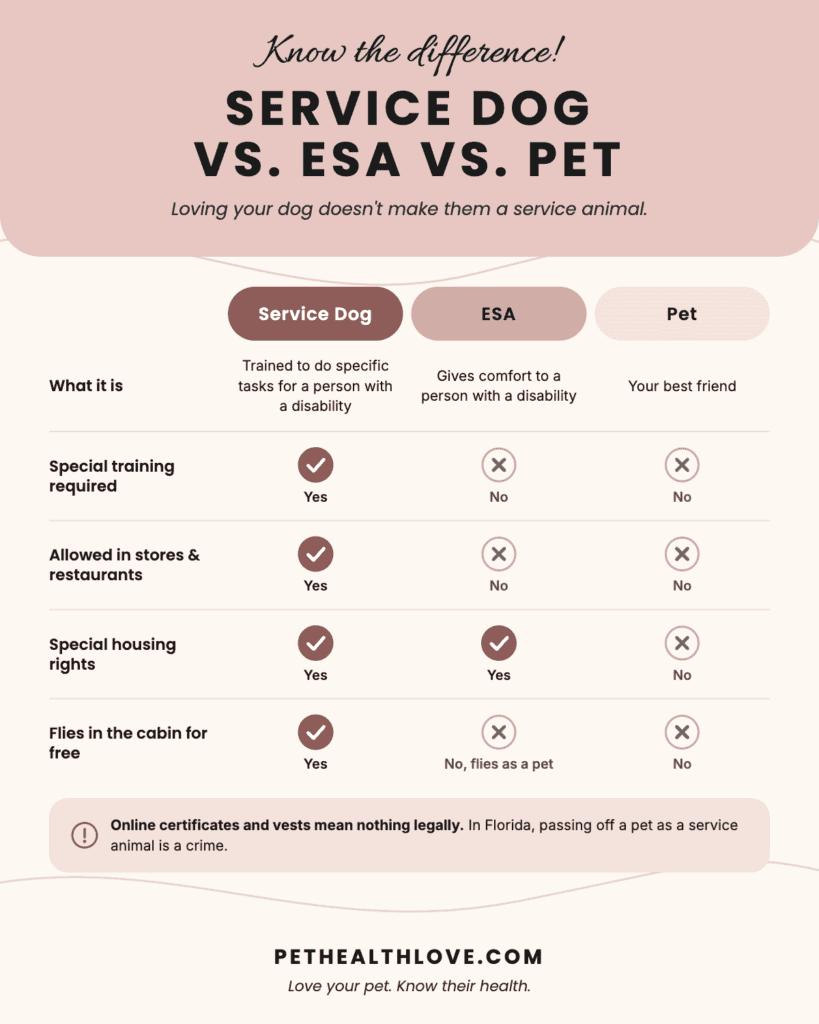
One important clarification: the ADA’s definition of a service animal generally covers dogs, with a separate provision for miniature horses. Other laws may use broader definitions.
A pet can provide tremendous emotional comfort without qualifying as an emotional support animal for disability-related housing accommodations.
And an ESA can provide legitimate disability-related support without having the public-access rights of a trained service dog.
The difference is not how much someone loves their animal. It’s the animal’s role, the person’s disability-related needs, and the applicable law.
What About Psychiatric Service Dogs?
This is where the distinction can become confusing.
Psychiatric service dogs are legitimate service animals under the ADA.
For example, a dog trained to recognize signs of an impending panic attack and perform a specific action to help its handler may qualify as a service animal.
Compare that with a dog whose presence makes its owner feel calmer or less anxious.
Both relationships may be meaningful, but providing comfort through companionship alone does not meet the ADA’s task-training requirement.
That’s why it’s important not to assume that someone with a psychiatric disability is simply bringing an emotional support animal into a public business.
A psychiatric service dog can have the same public-access protections as other service dogs.
Source: ADA — Frequently Asked Questions About Service Animals
So, Can You Bring Your Emotional Support Dog Into Publix?

If you don’t know what Publix is, it is a grocery store chain popular in the southeastern United States. Since I live in Florida, we have them everywhere.
Generally, no—not simply because the dog is an ESA.
And this is where I think some pet owners need a reminder.
Publix has an official service animal policy that allows qualifying service animals into areas open to the public.
However, the company’s policy specifically states that animals providing only emotional support, comfort, or companionship are not considered service animals.
Publix also prohibits service animals from being carried in shopping carts, even if a mat or blanket is placed underneath them.
The company asks that non-service animals be removed from its premises.
You can read the policy here: Publix Service Animal Policy.
So when I say your dog doesn’t need to come grocery shopping with you, I’m not talking about someone who relies on a trained service dog.
I’m talking about bringing an ordinary pet into a store that doesn’t permit pets simply because you want your dog with you.
There’s a difference.
And for rearl, I don’t think it’s unreasonable to expect pet owners to respect that.
Why Bringing Your Dog Everywhere Isn’t Always a Good Idea

Now let’s put the legal discussion aside for a moment and talk about something I know very well as a veterinarian: animal behavior and injuries.
I’ve treated dogs injured during interactions with other dogs.
I’ve seen what can happen when two unfamiliar dogs don’t get along, when an interaction escalates, or when one dog is significantly larger than the other.
And sometimes those injuries are serious.
One of my concerns about bringing pets into crowded public environments is that you cannot control how every animal around you will behave.
You might know your dog very well.
You might consider your dog friendly, gentle, and well-socialized.
But you don’t know the other dog standing three feet away.
You don’t know whether that dog is fearful, reactive, protective of its owner, or uncomfortable around unfamiliar animals.
And even a dog with no previous history of aggression can react defensively when frightened, startled, or overwhelmed.
Size differences can make dog interactions especially dangerous
Imagine a small dog approaching a much larger dog in a crowded store.
Maybe the little dog is excited and wants to say hello. Maybe the larger dog isn’t interested.
One growl, snap, or poorly managed interaction can quickly become a veterinary emergency.
That doesn’t mean large dogs are inherently aggressive. They’re not.
When two dogs are very different in size, the smaller dog is more likely to get seriously hurt if a fight breaks out.
I’ve treated enough injured dogs to know that I wouldn’t casually assume an interaction between unfamiliar pets will be safe.
And that’s one reason I’m selective about where I think pets should accompany their owners.
Even Pet Stores Aren’t Risk-Free

Now, I understand taking your dog to a pet store.
Pet stores are generally designed to accommodate animals, and many actively welcome customers who bring their pets.
If you want to take your dog shopping for a new toy or harness, that’s certainly different from bringing your dog into a grocery store that prohibits pets.
But even in pet-friendly businesses, I encourage owners to use caution.
Not every dog enjoys meeting unfamiliar dogs.
Not every dog is comfortable in crowded environments.
And not every pet owner recognizes the early warning signs of stress or fear.
If you decide to bring your dog to a pet-friendly store, keep your dog under control, respect other animals’ personal space, and avoid forcing interactions.
Your dog doesn’t need to greet every dog it sees.
In fact, sometimes the safest interaction is no interaction at all.
Are Emotional Support Animal Certificates Legitimate?
You’ve probably seen websites advertising emotional support animal registrations, identification cards, certificates, and special vests.
Some promise to make your pet an ESA after completing a short online questionnaire or paying a fee.
Here’s what pet owners should understand.
There is no official federal ESA registration or certification system that automatically grants an animal special legal privileges.
Under the Fair Housing Act, a person with a disability may request a reasonable accommodation for an assistance animal.
When the disability and disability-related need are not apparent, a housing provider may request reliable supporting information.
Simply purchasing an online certificate or identification card does not, by itself, establish eligibility for a housing accommodation.
Similarly, a service dog does not need an official federal registration or certificate to qualify under the ADA.
Sources: HUD Assistance Animals and ADA Service Animal FAQs.
Can a Business Ask Whether Your Dog Is a Service Animal?
Yes, but there are limitations.
When a dog’s service-animal status is not obvious, the ADA generally permits staff at covered businesses to ask two questions:
- Is the dog a service animal required because of a disability?
- What work or task has the dog been trained to perform?
Businesses generally cannot require documentation proving service animal certification, demand that the dog demonstrate its task, or ask someone to disclose their disability.
Service animals must also remain under their handler’s control and be housebroken.
A business may require removal of a service animal that is out of control when the handler does not take effective action, or one that is not housebroken.
These rules help protect access for people who legitimately depend on service animals while establishing expectations for animal behavior.
Source: ADA Service Animals
Does Your Dog Really Want to Go Everywhere With You?

Here’s another question I wish more pet owners would consider.
Just because you want your dog with you doesn’t necessarily mean your dog enjoys going everywhere.
Some dogs genuinely love outings and handle busy environments well.
Others find unfamiliar people, loud noises, shopping carts, slippery floors, and crowded spaces stressful.
Dogs may communicate discomfort through body language such as lip licking, yawning, trembling, avoiding eye contact, trying to move away, or holding their tails low.
These behaviors need to be interpreted in context, but they can indicate that a dog isn’t comfortable.
As pet owners, we have a responsibility to consider our animals’ emotional and physical well-being.
Sometimes that means including them in activities.
And sometimes that means allowing them to relax in a familiar environment at home.
Of course, dogs with separation-related distress may need an individualized behavior and management plan. Leaving a dog home isn’t automatically the best solution in every circumstance.
The point is to make decisions based on the animal’s needs, not simply our desire to have them with us.
Frequently Asked Questions
Can any dog be an emotional support animal?
Dogs of different breeds and sizes may qualify as emotional support animals when they provide disability-related support that meets applicable legal requirements. However, simply calling a dog an ESA does not automatically establish legal protections.
Can emotional support animals go into restaurants and grocery stores?
Under the federal ADA, emotional support animals do not have the same public-access rights as trained service dogs. State or local laws and individual business policies may provide additional permissions.
Can an emotional support animal fly for free?
Under current U.S. Department of Transportation rules, airlines are not required to recognize emotional support animals as service animals. Airlines may transport them under their ordinary pet policies, including applicable fees and restrictions.
Do service dogs have to wear a vest?
No. The ADA does not require service dogs to wear a vest, identification tag, or special harness identifying them as service animals.
Can a veterinarian certify an emotional support animal?
A veterinarian can evaluate an animal’s health, behavior, and suitability for certain environments. However, veterinary licensure alone does not establish the authority to diagnose a human disability or document a person’s disability-related need for an ESA.
That type of documentation, when required, generally involves an appropriately qualified human healthcare professional.
Can a service dog be removed from a store?
Yes, under certain circumstances. For example, a business may require removal if a service dog is not housebroken or is out of control and the handler does not take effective action. The person must still be offered the opportunity to obtain goods or services without the animal.
Final Thoughts | Loving Your Dog Doesn’t Mean Taking Him Everywhere
Let me end by saying this.
I love animals. I understand the emotional connection people have with their pets, and I believe that bond can be incredibly valuable.
I also respect the important role that emotional support animals play in the lives of people with disabilities.
And I fully support the rights of individuals who depend on trained service animals to navigate everyday life.
But I don’t believe ordinary pets need to accompany their owners into every public space.
Not every business is pet-friendly. Not every environment is appropriate for animals. And not every dog is comfortable being surrounded by unfamiliar people and pets.
Being a responsible pet owner sometimes means knowing when to leave your dog at home.
Your dog can be your best friend, your constant companion, and an important part of your family.
That doesn’t automatically make your dog a service animal.
And that’s okay.
Your pet doesn’t need a special title to be loved.
References
- U.S. Department of Justice. Service Animals — ADA.gov.
- U.S. Department of Justice. Frequently Asked Questions About Service Animals and the ADA.
- U.S. Department of Housing and Urban Development. Assistance Animals.
- Publix Super Markets. Service Animal Policy.
- U.S. Department of Transportation. Traveling by Air With Service Animals — Final Rule.
Disclaimer: This article provides general educational information about animal welfare and U.S. federal service-animal and assistance-animal rules. It is not legal advice. State and local laws may provide additional protections or requirements.


Dr. Georgina Ushi is a veterinarian and freelance medical writer. She earned her Doctor of Veterinary Medicine degree from the University of Florida College of Veterinary Medicine in 2009. Dr. Ushi has worked for 16 years in the Tampa Bay area, providing compassionate care to dogs, cats, and exotic pets.
In addition to her clinical work, she serves as an adjunct instructor at Florida A&M University, teaching in the veterinary technology program. Dr. Ushi also consults for pet well-being brands and writes evidence-based pet health content for Pet Health Love, as well as for PetMD. She is passionate about educating and empowering pet owners through clear, trustworthy information.
Her professional interests include emergency medicine, dermatology, pet telehealth, nutrition, and wildlife medicine.