

How to Start a Pet Blog: A Step-by-Step Guide for Beginners
Love pets and have something to share? Starting a pet blog can be a fun way to educate pet parents, build an online community, and potentially create an additional source of income.
I’m a veterinarian and the creator of Pet Health Love, and if I were starting a pet blog today, there are definitely some things I would do differently—and quite a few things I wouldn’t spend nearly as much time worrying about.
That’s why I created this guide.
I’m going to walk you through the basic steps of starting a pet blog, from choosing your niche and buying your domain to creating content, finding readers, and eventually monetizing your site.
One thing you won’t find here is a click-by-click WordPress tutorial filled with screenshots. Hosting dashboards, WordPress interfaces, plugins, and other blogging tools change constantly. Instead, I want to focus on the steps that actually matter so this guide remains useful even when the technology changes.
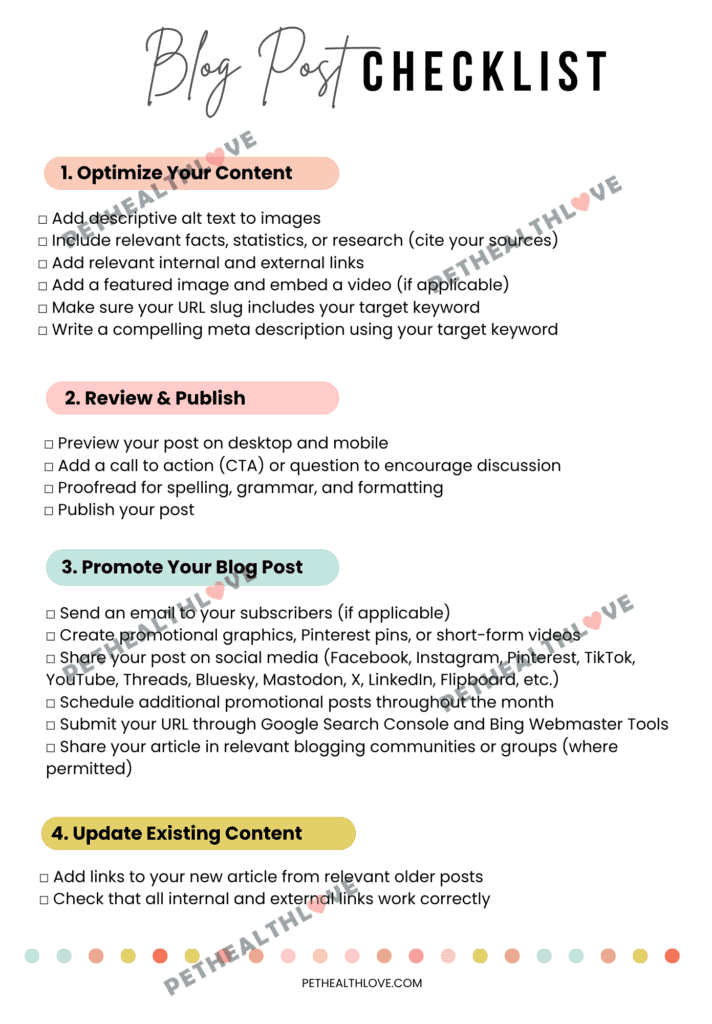
And when you’re ready to start publishing, I’ve also created a free Blog Post Checklist with the things you should check before you hit “Publish”—plus a few important things to do after your post goes live.
Affiliate Disclaimer: This post may contain affiliate links, which means we may earn a small commission if you purchase something through our links. This helps support our website and allows us to continue providing valuable content. See our full disclosure here.
1. Choose Your Pet Blog Niche

Before you start worrying about website colors, logos, or WordPress themes, you have to decide what you’re actually going to write about.
Your niche is essentially the main topic or focus of your blog.
For a pet blog, that could be something broad like dogs or cats, or something more specific such as:
- Pet health and wellness
- Pet nutrition
- Dog training and behavior
- Senior pets
- Specific dog or cat breeds
- Pet travel
- Pet product reviews
- Pet parenting on a budget
- New puppy or kitten care
- General pet lifestyle
- Exotic pets (guinea pigs, rabbits, birds, snakes, etc)
But here’s something I wish more new bloggers understood:
You don’t necessarily need to niche down until your blog is ridiculously specific.
You might hear advice telling you that your blog needs to focus on one extremely narrow subject in order to succeed. I don’t necessarily agree.
Starting a little broader gives you room to figure out what you actually enjoy writing about—and, just as importantly, what your audience wants to read.
You can always narrow your focus as your blog grows.
Be Clear About Your Expertise
There’s also an important distinction between sharing your experiences as a pet parent and providing medical information.
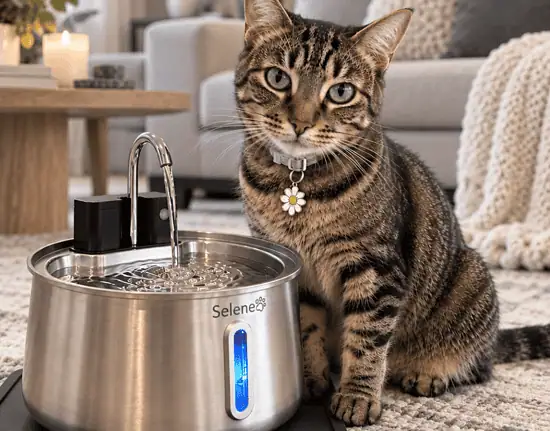
Anyone can share what it’s like to live with a puppy who destroys everything in sight or review the cat fountain their cat loves.
But if you’re writing about pet health, medications, diseases, nutrition, or other medical topics, be very careful about how you present that information.
Be transparent about your qualifications, use credible sources, and don’t present yourself as an expert in areas where you aren’t one.
Trust is incredibly important when you’re creating pet content.
2. Choose a Pet Blog Name

Now for one of the fun parts: naming your blog.
Ideally, your blog name should be:
- Easy to remember
- Easy to spell
- Related to your general topic
- Available as a domain name
- Available—or reasonably close to available—on the social media platforms you plan to use
Try not to choose something so specific that it boxes you in later.
For example, a name centered entirely around raising kittens might feel perfect when that’s what you want to write about. But what happens three years from now when you want to cover adult cat health, cat products, behavior, or senior cat care?
Give yourself a little room to grow.
When I came up with the name Pet Health Love, I liked that it gave me the flexibility to write about pet health while also covering pet products, pet ownership, emergency preparedness, and other topics that fit naturally within my brand.
Before committing to a name, search for it online, check whether the domain is available, and look at the major social media platforms to make sure another established creator or business isn’t already using it.
3. Buy Your Domain Name
Your domain name is simply your blog’s address on the internet.
For example:
pethealthlove.com
If possible, I recommend choosing a .com domain because it’s familiar and easy for people to remember.
Keep your domain relatively short and simple. Avoid unusual spellings, unnecessary numbers, or a bunch of hyphens that make it difficult for someone to remember or type correctly.
You’ll also want to consider domain privacy, which helps keep some of your personal contact information from being publicly displayed in domain registration records.
And remember: buying a domain isn’t usually a one-time purchase. You’ll need to renew it periodically, typically every year unless you purchase multiple years at once.
4. Choose a Web Host

This is where blogging terminology starts confusing people, so here’s the simplest way to think about it:
Your domain is your website’s address.
Your hosting company provides the server where your website’s files live.
WordPress is the software you use to build and manage the website.
They’re related, but they’re not the same thing.
When you’re comparing hosting companies, look at things like:
- Reliability and uptime
- Customer support
- Website speed
- Backups and security
- WordPress support
- Whether the hosting can grow with your site
You don’t necessarily need the most expensive hosting package when you’re starting your first blog. But I also wouldn’t choose a host based on price alone.
A cheap host isn’t much of a bargain if your site is constantly down or you can’t get help when something breaks.
The Hosting Company I Use
I currently use BigScoots to host Pet Health Love.

I chose BigScoots because I wanted hosting that could support my WordPress site as it grew, along with responsive support when I needed help.
I’m so glad I made the switch to BigScoots! When I first moved my website over, I was still getting used to everything and had to contact customer support several times. Every experience has been great! Whenever I open a support ticket, they respond almost immediately, even late at night, which is perfect because I’m a night owl.
Their team is always helpful, patient, and responsive.
Just because I use Big Scoots doesn’t automatically mean it’s the right host for every blogger, so compare your options and choose the hosting company that makes sense for your website, budget, and technical comfort level.
5. Install WordPress
If your goal is to build a serious blog that you may eventually want to monetize, WordPress is the platform I recommend considering.
This is also where you’ll hear two names that sound almost identical:
WordPress.org and WordPress.com.
They aren’t the same thing.
WordPress.org refers to the open-source WordPress software that can be installed on your own web hosting. This gives you much more control over your website, including your themes, plugins, advertising, affiliate links, and other monetization options.
WordPress.com is a hosted service with different plans and limitations.
For a self-hosted blog, you’ll typically purchase hosting and then install WordPress through your hosting provider.
Fortunately, many WordPress hosts make installation relatively straightforward.
Rather than following an old tutorial with screenshots that may no longer match what you see on your screen, use your hosting company’s current WordPress installation instructions.
6. Choose a WordPress Theme

Your WordPress theme controls much of your website’s appearance and layout.
And this is another place where it’s very easy to spend way too much time.
Ask me how I know.
There are thousands of free and paid WordPress themes available, and when you’re starting a website, it’s tempting to spend weeks trying to create the perfect design before publishing a single article.
Don’t.
Your first website does not need to look like one that’s been around for ten years.
Look for a theme that is:
- Mobile responsive
- Fast loading
- Easy to customize
- Regularly updated
- Well documented
- Compatible with WordPress and commonly used plugins
For Pet Health Love, I use a premium WordPress theme purchased through ThemeForest, part of Envato Market, along with Elementor, a drag-and-drop page builder.
Elementor allows me to customize different parts of my website visually without having to know how to code. I can adjust layouts, add design elements, and make changes without rebuilding everything from scratch.
I love having that flexibility, but I’ll also tell you that it’s easy to get carried away tweaking your website instead of actually creating content. Trust me, I’ve been there!
You can browse thousands of WordPress themes on ThemeForest, including themes designed to work with Elementor. Just make sure the theme you choose is actively maintained and compatible with your version of WordPress.
There are plenty of good free and paid options available, so don’t assume you need to spend hundreds of dollars when you’re just getting started.
Your goal at this stage is a clean, functional website that makes it easy for visitors to find and read your content.
You can always improve the design later.
7. Set Up Your Essential Blog Pages
Before—or shortly after—you launch your website, there are a few basic pages you’ll probably want to create.
Feel free to take a peek at the pages on Pet Health Love to get an idea of how I’ve organized mine! However, you’ll need to purchase your own legal page templates from a reputable provider or have them professionally prepared. While you can use other websites for inspiration, you shouldn’t simply copy someone else’s legal pages. Every website is different, and your policies need to reflect how your particular site operates.
About Page
Tell readers who you are, what your website is about, and why they should trust or follow your content.
This doesn’t need to be your entire life story. Focus on the information that’s relevant to your website and your audience.
Contact Page
Give readers a way to reach you.
This becomes even more important as your site grows because brands, PR companies, potential sponsors, and other businesses may use your contact page to reach out about opportunities.
Privacy Policy
Your website may collect information through analytics, email sign-ups, cookies, advertising, or other tools. Your privacy policy explains how information is collected and used.
Disclaimer
Depending on what you write about, you may also need appropriate disclaimers.
For example, Pet Health Love provides educational pet health information, but online content is not a substitute for an examination and individualized advice from a veterinarian who has evaluated your pet.
Affiliate Disclosure
If you use affiliate links, readers need to know that you may receive compensation when they purchase through those links.
Depending on your website and business, you may also need Terms and Conditions or other legal pages.
One important tip: Don’t assume that a free legal template you find online will automatically cover everything your website needs. Purchase templates from a reputable legal template provider, or consult a qualified attorney to make sure your policies are appropriate for your website.
Legal requirements vary depending on where you live, your audience, what information you collect, and how your site operates. Even purchased templates may need customization, and they aren’t necessarily a substitute for individualized legal advice.
8. Decide What You’re Going to Write About

You have a website.
Now you need something for people to read.
Instead of randomly choosing a topic every time you sit down to write, create a few content pillars or categories.
For example, a cat blog might have:
Cat Health | Cat Behavior | Nutrition | Products | New Cat Parents
Now you can brainstorm articles underneath each category.
Here are a few pet blog post ideas you could adapt to your particular niche:
- New puppy checklist
- New kitten checklist
- How much water should my cat drink?
- How much water should my dog drink?
- Signs your pet needs to see a veterinarian
- Pet emergency preparedness checklist
- Best supplies for new pet parents
- How to prepare for your pet’s first vet visit
- Tips for traveling with pets
- Ways to save money on pet care
- Senior pet care tips
- Holiday pet safety tips
- Summer pet safety tips
- How to choose a pet carrier
- Pet products you actually use and recommend
Start Thinking About Search Intent
Before writing an article, ask yourself:
What is the person searching for this topic actually trying to find out?
That’s search intent.
Someone searching “how much water should my cat drink” probably wants a fairly direct answer—not a 700-word story about your childhood cat before you finally answer the question.
Someone searching “new puppy checklist,” on the other hand, may want a comprehensive list of everything they should buy and prepare before bringing their puppy home.
Understanding what the reader wants makes it much easier to create genuinely useful content.
Keyword research and SEO can get much more complicated than that, but understanding search intent is a good place to start.
9. Write and Publish Your First Blog Posts
You don’t need 30 perfectly optimized articles before launching your website. You just need to start writing!
Begin with a few helpful articles that answer common questions or solve problems for your audience.
Keep your content easy to read by using clear headings, short paragraphs, and relevant images. Include credible sources when discussing pet health topics, and link to other helpful articles on your website.
And please, don’t feel like every article needs to be 3,000 words long! Some topics require detailed explanations, while others can be covered in a few hundred words.
Focus on providing useful information, not meeting an arbitrary word count.
Before publishing, proofread your article, check your links, and preview it on your phone.
I’ve created a free checklist to help you remember everything.
GET MY FREE Blog Post Checklist
10. Learn Basic SEO and Promote Your Content
SEO (search engine optimization) helps search engines discover and understand your website.
It’s worth learning the basics, such as writing descriptive titles, organizing articles with headings, linking to related content, and making sure your website works well on mobile devices.
But here’s my advice: Don’t become obsessed with Google rankings.
I’ve spent plenty of time worrying about SEO and search traffic. Eventually, I decided to focus more on creating helpful content and finding other ways to reach readers.
Remember, Google isn’t the only way people can discover your website!
Social media platforms like Pinterest, Facebook, Instagram, and TikTok can also help you attract visitors.
You don’t need to be everywhere. Choose a couple of platforms you enjoy and focus on those.
And don’t forget to repurpose your content! One article can become a Pinterest pin, Instagram reel, Facebook post, or email newsletter.
Start Building an Email List
I also recommend starting an email list early.
Unlike social media, where algorithms determine who sees your content, an email list gives you a more direct connection with your subscribers.
You can encourage sign-ups by offering a free resource, such as a pet care checklist or printable guide.
I currently use Kit (formerly ConvertKit) for my email marketing, but there are several services available.
11. How to Make Money With Your Pet Blog

Now for the question everyone wants answered.
Can you actually make money with a pet blog?
Absolutely, it’s possible! But don’t expect to start earning hundreds or thousands of dollars overnight.
Here are some common ways website owners generate income:
- Affiliate marketing: Earn commissions by recommending products or services through affiliate links.
- Display advertising: Earn revenue from advertisements displayed on your website.
- Sponsored content: Partner with brands to create paid articles, reviews, or promotional content.
- Digital products: Sell downloadable planners, checklists, guides, or other resources.
- Freelance opportunities: Use your website to showcase your expertise and attract potential clients.
I currently monetize Pet Health Love through affiliate partnerships, Mediavine advertising, sponsored content, and digital products.
And here’s something I’ve learned: You don’t need millions of pageviews to create income opportunities.
Building relationships with brands, developing an engaged audience, and recommending products that genuinely fit your niche can also create opportunities.
However, income isn’t guaranteed, and results vary considerably.
One more thing: Never recommend a product simply because it pays a commission. Your readers’ trust is far more valuable than a quick sale.
12. Be Patient and Don’t Give Up
If there’s one piece of advice I want you to remember, it’s this:
Building a successful website takes time.
When I started Pet Health Love, I wanted to share my veterinary knowledge and help pet owners. Of course, I also hoped my website would eventually generate income.
But it hasn’t always been easy.
I’ve dealt with declining website traffic, disappointing earnings, and plenty of frustration along the way.
There were times when I wondered whether all the hours I spent creating content would ever pay off.
Eventually, I told myself that even if Pet Health Love never became a significant source of income, I would continue working on it because I genuinely enjoyed it.
And I’m so glad I didn’t give up!
Today, my website generates income through advertising, affiliate partnerships, and other opportunities that I’ve worked hard to develop.
I’m still learning, experimenting, and figuring things out.
And that’s okay!
You don’t have to have everything figured out before you begin.
Your first articles won’t be perfect. Your website design will change. You’ll make mistakes and discover better ways of doing things.
That’s all part of the process.
Ready to Start Your Pet Blog?
Starting a pet blog doesn’t have to be complicated or expensive.
Choose a niche you enjoy, create a functional website, and start publishing content that helps your readers.
Don’t spend months trying to make everything perfect before you begin.
And most importantly, have fun with it!
Before publishing your first article, grab my free Blog Post Checklist to help you stay organized.
DOWNLOAD THE FREE BLOG POST CHECKLIST
Happy blogging!


Dr. Georgina Ushi is a veterinarian and freelance medical writer. She earned her Doctor of Veterinary Medicine degree from the University of Florida College of Veterinary Medicine in 2009. Dr. Ushi has worked for 16 years in the Tampa Bay area, providing compassionate care to dogs, cats, and exotic pets.
In addition to her clinical work, she serves as an adjunct instructor at Florida A&M University, teaching in the veterinary technology program. Dr. Ushi also consults for pet well-being brands and writes evidence-based pet health content for Pet Health Love, as well as for PetMD. She is passionate about educating and empowering pet owners through clear, trustworthy information.
Her professional interests include emergency medicine, dermatology, pet telehealth, nutrition, and wildlife medicine.